AI Is Changing Legal Marketing.
But Is It Changing What Makes It Work?
Years ago, when I entertained ambitions of becoming a published writer, getting something into print was no small accomplishment. You couldn't simply write an article, press a button, and broadcast it to the world. You had to convince someone else it was worth publishing.
That usually meant sending query letters to magazine editors, often accompanied by a self-addressed stamped envelope so they could return your rejection. And where you were published mattered. Getting an article into Playboy, for example, was a very different accomplishment from appearing in the local Pennysaver, somewhere between advertisements for muffler repairs and used refrigerators.
The internet changed all that.
Suddenly, anyone could become a publisher. Blogging platforms made it possible to reach an audience without owning a printing press, knowing anyone in the publishing business, or possessing much technical expertise. The barriers to publication largely disappeared.
Artificial intelligence has taken that transformation a step further. Now you don't even have to be particularly good at writing. Give ChatGPT a topic, a few instructions, and perhaps a preferred tone, and it can produce a reasonably polished article in seconds.
For law firms, this presents an extraordinary opportunity. It also creates a problem.
The problem is no longer getting something published.
The challenge is producing something worth reading.
When Everyone Sounds the Same
Of course, the proliferation of forgettable content didn't begin with artificial intelligence. Long before ChatGPT entered the picture, law firms were publishing an endless stream of articles that were informative enough, but largely indistinguishable from one another. The objective wasn't always to offer a fresh perspective or say something particularly insightful. Often, it was simply to occupy another little corner of Google's search results.
I know because I've written some of that material myself, one soldier in an army of content writers working behind the scenes for marketing agencies. We did the grunt work, churning out reams of information that, more often than not, sounded essentially the same.
It became especially monotonous with personal injury assignments. I sometimes felt like Dean Winters playing Mayhem in those Allstate commercials—the guy who personifies everything that can possibly go wrong. I wrote about calamities of every description: the perils of operating jet skis, the lasting trauma of an encounter with a vicious dog, or dangerous mold lurking behind the bedroom wall of a sleeping child.
There was a method to the madness.
Legal content marketing sometimes felt like an elaborate game of Mad Libs. Insert the practice area, substitute the relevant injury or legal problem, sprinkle in the target keyword a few times, and finish with a heartfelt invitation to contact our experienced attorneys.
Then we'd offer our literary masterpiece as a sacrifice to the Google gods, hoping the search engine would reward our efforts with a few visitors. Never mind that a hundred other law firms were performing essentially the same ritual, often with remarkably similar results.
AI makes producing that kind of vanilla, cookie-cutter material easier than ever. It can explain statutes, summarize legal procedures, and turn a short outline into a respectable-looking article in seconds.
And you think it's awesome. Because it is. But here's the catch: You haven't raised the bar simply by using AI. You don't have a monopoly on the technology. The law firm down the street has discovered it, too, and they're using the same widely available tools to churn out content that could just as easily appear on your website.
We've made it remarkably easy to produce more content. We haven't necessarily made that content any more remarkable.
Legal marketers need to recognize that the secret to standing out from the pack doesn't lie in better prompts or more sophisticated software. It's having something worthwhile to say in the first place.
What an Experienced Attorney Knows That ChatGPT Doesn't
ChatGPT is an extraordinary resource for getting oriented on an unfamiliar legal issue. It can explain statutes, summarize court decisions, identify potential remedies, and help people understand their options before consulting an attorney.
Chances are, you've already encountered people in your practice who explored their legal questions with AI before coming to you. Increasingly, people seeking legal help are doing their homework first, posing questions to a chatbot before ever visiting a law firm's website.
Yet there's a considerable divide between understanding the law in theory and knowing how it plays out in real life. Experienced attorneys bring something else to the table: the ability to anticipate problems, recognize risks, and appreciate the human dynamics of legal disputes. That kind of judgment comes from experience, not from generating another explanation of the law.
The Cost of Not Asking First
Recognizing legal obstacles before a client makes an expensive decision.
A loving father has a daughter who's college-bound. Before her first semester begins at a Southern California university, a practical question arises: where will she live? The father purchases a tenant-occupied duplex in Los Angeles, intending for his daughter to occupy one unit while generating rental income from the other.
Only after closing does he discover that local tenant protections prevent him from recovering possession. One of the tenants is 68 years old and has lived in the apartment for nearly two decades, making her a protected tenant under Los Angeles' rent stabilization rules. The father cannot simply evict her to make room for his daughter.
He's committed a substantial sum of money to a property that doesn't serve its intended purpose. Now he faces the additional expense of housing his daughter elsewhere, while the existing tenants are perfectly content with their rent-controlled apartments and have no intention of leaving.
An attorney experienced in the nuances of landlord-tenant law could have warned the father to investigate owner and relative move-in eviction restrictions before purchasing the duplex. ChatGPT might eloquently explain the legal framework for recovering possession to house an owner's close relative, but overlook the critical detail that certain tenants are protected from displacement under those very provisions.
The real value isn't simply knowing the law. It's recognizing the problem before someone makes a very expensive mistake.
When Winning Isn't the Point
Understanding when pursuing a legal remedy may be unwise.
Consider another situation. A landlord discovers that an apartment is occupied by far more people than the lease permits. Several generations of a low-income immigrant family are living under one roof because they simply cannot afford separate housing. The landlord wants to pursue an eviction for overcrowding.
ChatGPT might explain the applicable occupancy rules, identify potential lease violations, and outline the steps involved in pursuing an unlawful detainer action.
But an experienced attorney sees another problem developing.
The family has faithfully paid its rent and otherwise been a model tenant. Now the landlord wants to put them out on the street because too many relatives are sharing an apartment. What initially looked like a straightforward lease violation has become a political hot potato.
Picture the landlord's attorney trying to convince a judge or jury that this family should lose its home. How receptive will they be? Sympathy doesn't override the law, but it can influence how disputed facts and testimony are received. And even where the landlord has a legitimate legal argument, prevailing may be far more difficult, expensive, and uncertain than anticipated.
An experienced attorney might advise the landlord to reconsider the eviction altogether, explore other ways to address the overcrowding, or simply recognize that this isn't a battle worth fighting.
ChatGPT may identify a legal argument. An experienced attorney knows when making that argument could be a very expensive mistake.
What Happens When People Stop Searching and Start Asking?
For years, law firms relied on search engine optimization (SEO) to attract prospective clients through Google. They invested in content, keywords, backlinks, and website performance to improve their rankings and drive traffic to their websites.
That strategy still matters. But increasingly, people are getting answers without ever clicking through to a website.
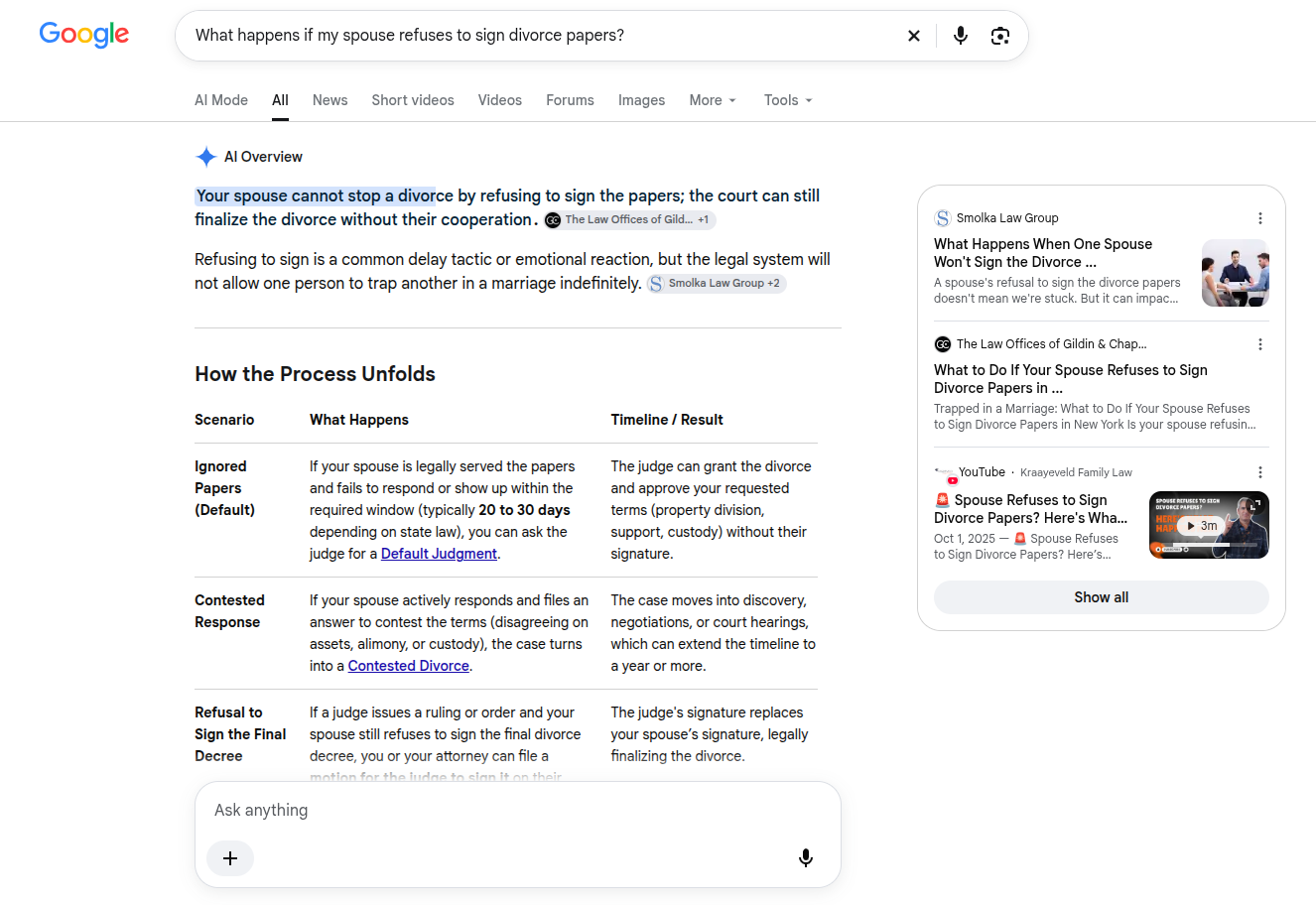
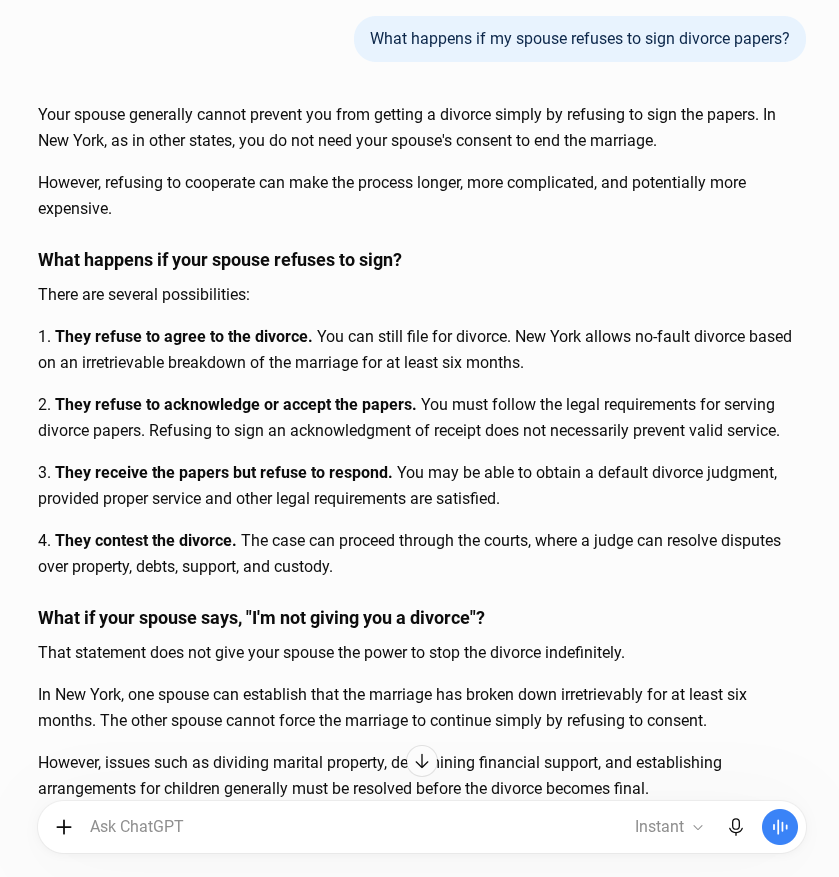
Consider a common legal question: "What happens if my spouse refuses to sign divorce papers?"
I posed that exact question to both Google and ChatGPT. The results illustrate how the delivery of legal information is changing.
Google Search
ChatGPT
The Answer Comes Before the Click
Google and ChatGPT are no longer as different as we might assume. Google increasingly provides AI-generated answers directly within its search results, while ChatGPT delivers conversational explanations that invite follow-up questions.
In both examples, someone contemplating divorce receives substantial legal information without visiting an attorney's website. They can learn about their rights, understand their options, and begin deciding what to do next.
This doesn't make law firm websites irrelevant, nor does it mean traditional SEO is obsolete. But it changes the challenge. Ranking prominently in search results is no longer the only way prospective clients discover legal information.
The question is no longer just whether people can find your website. It's whether your expertise can be found when AI delivers the answer.
Beyond SEO: Understanding AEO and GEO
As search evolves, two additional terms have entered the digital marketing vocabulary: Answer Engine Optimization (AEO) and Generative Engine Optimization (GEO). Both reflect the growing importance of making information accessible to AI-powered systems.
Search Engine Optimization (SEO) focuses on improving a website's visibility in traditional search results. The objective is to help prospective clients find and visit your website.
Answer Engine Optimization (AEO) focuses on presenting information in ways that make it easier for search engines and AI-powered tools to identify and deliver direct answers to users' questions.
Generative Engine Optimization (GEO) focuses on making content discoverable, credible, and useful to generative AI systems that synthesize information from multiple sources into responses.
These disciplines overlap considerably. Clear writing, authoritative information, sound website structure, and useful original content can support all three. The distinction is less about abandoning SEO than recognizing that visibility now extends beyond a list of search results.
What Does This Mean for Law Firms?
For attorneys, the implications go well beyond making their websites easier for search engines to find.
Consider someone facing a legal problem. They may not know which attorney to call, which area of law applies, or even whether they have a viable case. Increasingly, they can turn to AI, describe their circumstances in everyday language, and receive an explanation of their options—sometimes accompanied by recommendations for legal representation.
That creates an opportunity for law firms whose websites do more than describe their services. Firms that consistently publish useful information, address specific legal problems, and demonstrate their experience may be better positioned to appear in these AI-generated responses.
But does it actually work?

Putting AI Recommendations to the Test
Rather than speculate about whether ChatGPT recommends attorneys, I decided to put it to the test.
I posed three realistic questions involving landlord-tenant disputes in San Francisco, Berkeley, and Oakland. Each described a different legal problem and asked ChatGPT to recommend an experienced attorney.
Here are the actual questions I asked:
- San Francisco — Nonpayment of Rent: “My tenant in San Francisco hasn't paid rent in several months, and I'm thinking about eviction. Can you recommend an experienced attorney who handles these kinds of cases?”
- Berkeley — Family Member Move-In: “I own a rental property in Berkeley, California, and I'm considering moving a family member into one of the units. I've heard Berkeley has very strict rent control and eviction laws, and I don't want to make an expensive mistake. Can you recommend an experienced attorney who represents landlords and can advise me on my options?”
- Oakland — Tenant Nuisance: “I'm a landlord in Oakland, California, and my tenant has been causing problems with other residents in the building. I've received several complaints, but the tenant refuses to change their behavior. Can you recommend an experienced attorney who represents landlords and understands Oakland's eviction and rent control laws?”
In all three responses, Bornstein Law appeared as the first recommendation. The screenshots below show the actual results.
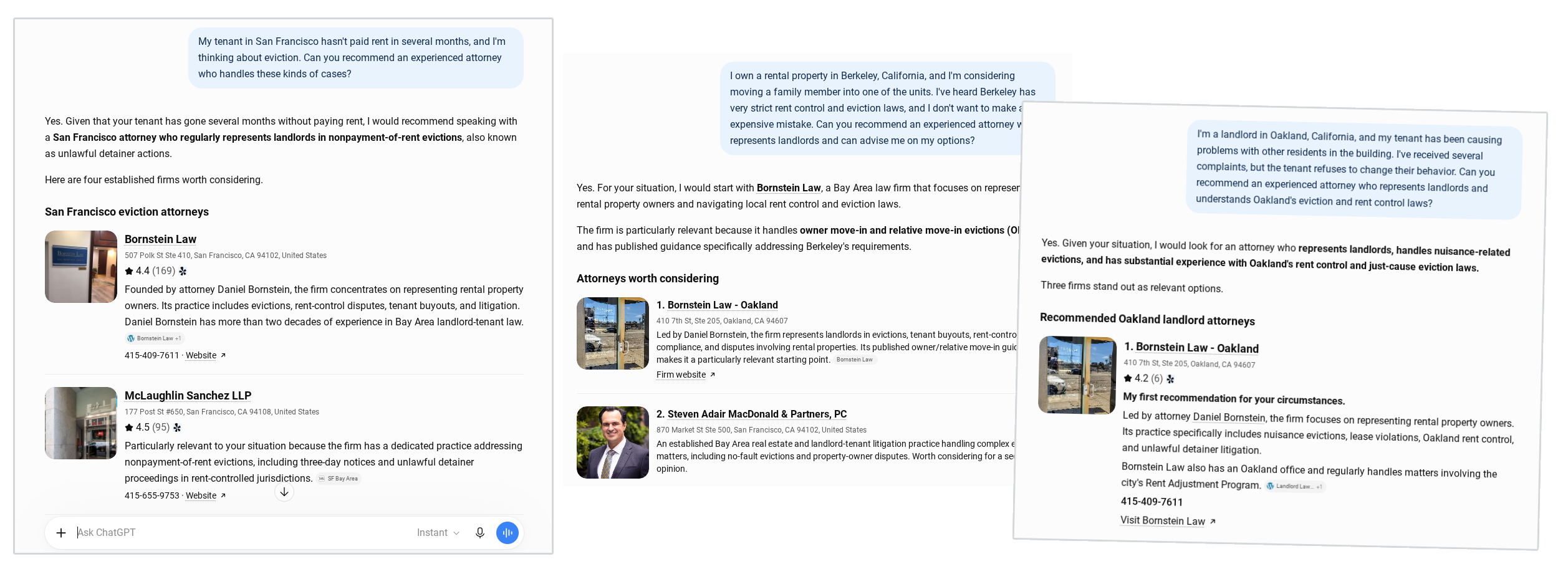
These results are encouraging, but they come with an important qualification. ChatGPT does not maintain a fixed ranking of attorneys, and another person asking the same questions might receive different recommendations. Responses can vary depending on how a question is phrased, the context of the conversation, and the information available to the AI system.
Nor can I claim to know precisely why Bornstein Law appeared first in all three examples.
What I can say is that these results didn't happen in a vacuum. They followed years of work building the firm's digital presence— developing its website, publishing substantive legal content, addressing local regulatory developments, and making its attorneys' experience and insights accessible online.
Does that prove a direct cause-and-effect relationship? No. But it illustrates the kind of digital visibility that legal marketers should be thinking about as prospective clients increasingly turn to AI for guidance and recommendations.

What an Experienced Attorney Knows That ChatGPT Doesn't
ChatGPT is an extraordinary resource for getting oriented on an unfamiliar legal issue. It can explain statutes, summarize court decisions, identify potential remedies, and help people understand their options before consulting an attorney.
Chances are, you've already encountered people in your practice who explored their legal questions with AI before coming to you. Increasingly, people seeking legal help are doing their homework first, posing questions to a chatbot before ever visiting a law firm's website.
Yet there's a considerable divide between understanding the law in theory and knowing how it plays out in real life. Experienced attorneys bring something else to the table: the ability to anticipate problems, recognize risks, and appreciate the human dynamics of legal disputes. That kind of judgment comes from experience, not from generating another explanation of the law.
Six Things Legal Marketers Can Do Right Now
AI is changing how prospective clients discover legal information and find attorneys. While no strategy can guarantee a recommendation from an AI platform, there are practical steps law firms can take to make their expertise more visible, accessible, and useful.
Start With Real Questions
Create content around the questions prospective clients actually ask, using their language rather than legal jargon.
Offer Original Insight
Go beyond generic legal explanations. Share practical experience, real-world scenarios, and perspectives that distinguish your firm.
Structure Your Content
Use descriptive headings, direct answers, and logical organization so readers and AI systems can understand your expertise.
Build Credibility
Maintain accurate attorney profiles, professional listings, and credible references beyond your own website.
Keep Information Current
Revisit older articles, address important legal developments, and demonstrate that your firm remains engaged in its practice areas.
Test Your AI Visibility
Ask AI platforms realistic questions about finding legal representation. Examine the responses and identify opportunities to improve.
How Lawyers Describe Problems vs. How Clients Ask About Them
Attorneys organize their websites around practice areas. Prospective clients often begin with a question about something happening in their lives.
| Legal Terminology | What a Prospective Client Might Ask |
|---|---|
| Employment Discrimination | "Can my employer fire me because I'm pregnant?" |
| Estate Litigation | "My brother is refusing to show me our mother's will. What can I do?" |
| Bankruptcy | "Can I keep my house if I file for bankruptcy?" |
| Criminal Defense | "Do I have to answer police questions if I haven't been arrested?" |
| Family Law | "Can my ex move out of state with our children?" |
If AI Can Do the Work, Why Hire a Marketing Professional?
It's a fair question. If an attorney can ask ChatGPT to write an article, draft a newsletter, suggest improvements to a website, or develop a social media campaign, why pay someone else to do those things?
The answer begins with a distinction between producing marketing materials and developing a marketing strategy.
AI can generate a remarkably competent article in seconds. What it cannot independently determine is whether that article is worth publishing, whether it addresses a problem prospective clients actually care about, or whether another investment of the firm's time and resources would produce better results.
A law firm doesn't necessarily need more content. It needs the right content, presented to the right audience, in a way that distinguishes the firm from its competitors.
That requires understanding the practice itself. Who are the firm's ideal clients? What problems bring them through the door? What misconceptions do they have about the law? What makes the attorneys particularly effective at solving those problems? And how can those qualities be communicated in a crowded marketplace where nearly everyone claims to be experienced, knowledgeable, and dedicated to client service?
These are strategic questions, not writing assignments.
Then comes execution. An effective digital presence involves much more than publishing an occasional article. There are websites to maintain, practice areas to develop, legal developments to follow, newsletters to distribute, search visibility to monitor, and opportunities to recognize before competitors do. Each activity should reinforce the others rather than exist as an isolated marketing exercise.
AI can make many of these tasks easier. It doesn't eliminate the need for someone to decide what matters, coordinate the work, maintain quality, and evaluate whether the effort is accomplishing anything.
There is also the question of time.
An attorney may be perfectly capable of writing a compelling article or learning the intricacies of search engine optimization. But every hour spent managing a website, experimenting with AI prompts, or preparing an email campaign is an hour not spent practicing law, serving clients, or developing the expertise that makes the firm's marketing valuable in the first place.
The objective isn't to replace the attorney's voice with a marketing professional's voice. It's to bring that voice to a larger audience without requiring the attorney to become a full-time publisher, designer, and digital strategist.
A good marketing professional becomes more than someone who takes orders for another blog post or newsletter. They learn the business, recognize opportunities, ask better questions, and help the firm communicate what makes it worth hiring.
AI is an extraordinarily useful tool in that process. But knowing how to operate the tool and knowing what to accomplish with it are two different things.
The Human Element Isn't Going Away
When I first started freelance writing, getting published meant finding an editor willing to give my work a chance. I'd prepare a submission, put it in an envelope, affix a stamp, and hope for a favorable response. Sometimes the answer was no. Sometimes there was no answer at all.
The internet changed that. Suddenly, anyone could publish without asking an editor for permission. Today, artificial intelligence has taken things another step further. You don't even have to write everything yourself.
Each advance has made it easier to put words in front of an audience. But easier publication hasn't necessarily made those words more interesting, insightful, or worth reading.
If anything, the abundance of content has made originality and perspective more valuable.
And there's another consideration, particularly important for attorneys: AI can be spectacularly wrong, even when it sounds absolutely certain of itself.
When AI Invents the Law
Consider what happened to Los Angeles eviction attorney Dennis Block. In 2023, his firm was sanctioned after submitting a court filing that cited cases that didn't exist. The authorities appeared legitimate, complete with case names and citations. There was just one problem: they were fictional.
The sanction was one dollar below the threshold that would have triggered mandatory reporting to the California State Bar. The episode subsequently became part of a larger disciplinary matter.
The danger isn't just that AI makes mistakes. It's how convincing those mistakes can sound.
Although this happened in a courtroom rather than on a law firm's website, the lesson for legal marketing is much the same.
A polished article that misstates the law, invents a legal authority, or overlooks a critical exception can undermine the very reputation it was intended to strengthen.
None of this means attorneys should avoid AI. Quite the contrary. Used thoughtfully, it can be an extraordinary research, writing, and productivity tool. But it requires a healthy dose of skepticism, particularly when dealing with legal authorities, jurisdiction-specific rules, and rapidly changing laws.
In future articles, I'll explore practical ways to reduce the risk of AI-generated errors and hallucinations, including how to structure prompts, verify sources, and recognize when an answer deserves closer scrutiny. No method can guarantee accuracy, but there are ways to make these tools considerably more reliable.
And that brings us back to the central question.
As AI becomes more capable, the ability to produce content will become less of a competitive advantage. What will matter increasingly is the knowledge, experience, and judgment behind it.
For attorneys, that means understanding the law, anticipating complications, and knowing when the seemingly obvious answer is the wrong one. For those responsible for marketing their services, it means recognizing those qualities and making them visible.
The goal isn't to produce more material simply because technology makes it possible. It's to create something worth reading, remembering, and trusting.
The tools will continue to change. The ways people search for information and choose professionals will change with them.
But the fundamental challenge will remain remarkably familiar.
Technology can help communicate that reason. It cannot invent one.
Want to make your firm's expertise more visible? Let's talk.